Transitions

November 11, 2009

The uncertainty that has plagued my (non-art) professional life has made it difficult to focus on or execute things that I want to do with my art over this past year or so. As it settles down, (which it is now doing) I can start to put some of my attention back here where it belongs and ramp up my web site re-design and the creation of some new work.

In addition to the website redesign and determining what my next photographic project will be, here are some of the things I’m kicking around:

  • Running a scavenger hunt exhibit annually. It’s a big commitment but we really got a good response to the exhibit and the exposure I received was also very good. I’ve had several people who participated in the hunt tell me that they’d love to do it again and suggested we should do it annually. So I had a chat with Julie Wolcott, the director of the Central Wisconsin Cultural Center (CWCC), where the exhibit was held and she thought it was a good idea. We’re currently mulling it over.
  • Starting a podcast. I’ve been talking about this with Tammy Kempfert, our blogrunner here, and I just recently purchased some recording equipment to start playing with while I continue to let the podcast idea marinate. I’ll elaborate on my love of podcasts in a separate post.
  • Teaching more classes. I teach a Beginning Digital Photography class at the CWCC. It’s a class I’ve been teaching for 2 years now (I think, jeez, I can’t remember when I started it!) and I LOVE teaching it. I originally went to college to become a teacher, and while I never completed that degree I ended up teaching anyway!

One of the things I expect and plan to make a strong component of my overall revenue plan is the teaching that I do. I’ve had great success with the Beginning Digital Photography class and I’m now ready to expand my offerings.

I’m currently putting together a curriculum outline for an Advanced Digital Photography class (For point and shoot style cameras) and an Advanced SLR photography class that would cover film and digital cameras.

In addition to those classes I’d like to offer a class on editing and printing photos but I have to figure out the logistics since I don’t have a computer lab at my disposal.

Finally I’m starting to think about some guided style photography workshops. Wisconsin is ripe with places to go for these kinds of workshops so I’d just need to do some scouting for locations that I could build a full program around.

Combining my skills as an instructor on the front end with what I hope to build through my website in the backend will be my two-pronged approach to a sustainable revenue for through my photography. Those won’t be the only two prongs but I hope they will grow into the strongest.

-Spyros Heniadis


Let’s tweet about schools and the arts

November 6, 2009

twitbirdNew York City schools with best access to arts programs have higher graduation rates, study says. http://tinyurl.com/yfhabp9.

My opening sentence reproduces a tweet I composed a couple of weeks ago for Portal Wisconsin’s recently born Twitter stream. At 124 characters, the message gave notice to a  brief article that caught my attention that day and fit neatly within Twitter’s 140-character limit. When I clicked the “update” button, I thought the tweet was benign enough (and, if I’m being honest, even a little banal). But in fact, it ruffled the feathers of an @portalwisconsin follower, which got me thinking about using this blog and micro-blogs like Twitter to facilitate discussions on arts-related topics.

In a series of reply-tweets, the offended follower raises an interesting question regarding arts education research. He argues that we shouldn’t strive to quantify relationships between classes in the arts and standardized test scores. Attempts at establishing this sort of causality, he says, miss the mark: we need to change the focus of the discussion to one that champions the intrinsic value of arts education, or “arts must b suprtd 4 sake of arts edu not 4 sake of anthng els! it gvs wel-rounded knowldg & edu, & anothr way of thnkng,” to quote one of his tweets. In his view, the study I linked to amounted to “junk science.”

Point taken, sort of.

I whole-heartedly agree that many learning experiences, like listening to an opera or visiting an art museum, can’t really be measured. I believe the arts play an integral role in a well-rounded education–or in educating the whole child, as has become the popular expression. And I regret that federal rules require teachers to devote more and more class time to those skills we perceive as easy-to-measure, at the expense of other less quantifiable skills.

On the other hand, the study I cited does not claim arts education improves student test scores in core subject areas; it only says schools with strong arts programs have better graduation rates. This is why my tweet originally seemed banal to me: while I’ll  own up to some bias, my personal logic tells me that the arts help engage kids in school, and when kids are engaged, they more likely show up. To me, that relationship seems a natural one, and hardly earth-shattering news. As for the research into whether art classes improve geometry scores and the like, I simply don’t have the scientific expertise to know for sure.

So why do I bring up my first-ever Twitter tiff here, rather than on Twitter? Not because this blog allows me unlimited characters with which to make my point. In fact, often I prefer the enforced brevity of Twitter, and I initially composed a couple of quick replies. I wound up not posting them, in the end (or posting one, then deleting it), to avoid confusion between Portal Wisconsin, the Web site, and my personal opinions.

As Portal’s resident twitterer, I’ve attempted to write varied messages–posting news from our Cultural Coalition partners, featuring the latest Portal Wisconsin blog posts, spotlighting sometimes overlooked sections of the site, even live-tweeting from the Wisconsin Book Festival, about anything related to arts, history and culture that captures my attention.  However, I would avoid tweets that give the impression that my views reflect those of our entire organization. On this blog, I can more easily own my words.

What do you think? Should educators, researchers and arts advocates even attempt to link art and math and science learning? Are there better gauges of achievement in arts programs? It’s a tough question, given the trend toward narrowing the curriculum and the increased reliance on standardized testing as a measure of school success.

I would love for blog readers and Twitter followers to continue the conversaton. If we can help each other think more deeply about arts, culture and education, as @BorisMakesArt helped me do on Twitter, I will consider our early adventures in social media worthwhile. At Portal Wisconsin, we want to find ways to engage Wisconsin residents in the rich world of art, culture, history and thought that characterizes our state. (My last sentence, incidentally, is one I can confidently say does reflect the opinions and mission of our entire organization.)

–Tammy Kempfert


What I learned from John T Unger today

November 5, 2009

Just got off a conference call with John T Unger hosted by Alyson B. Stanfield of artbizcoach.com.

It’s amazing what you can learn in a half hour of listening. As I mentioned in my other post I think about copyright often, and while I’ve never had an issue with it, today I learned some very important things that artists should be aware of.

Full disclaimer, I am not a lawyer and this is not legal advice. Consult your attorney if you have questions regarding copyright law.

1. There are several layers of copyright documentation. The only one that allows you to take your case to federal court (copyright law is federal law) is to document your claims by filing for copyright with the copyright office.

You have a copyright claim by virtue of creating an original work, and placing a notification on the work helps a little, but without that documentation you limit your legal options to protect your work.

2. Filing for copyright is not that expensive. You can file for copyrights online at copyright.gov, and a basic copyright filing costs $35 (source: copyright.gov/eco) if done online. You can also file for copyrights of collections, so you don’t have to file a copyright for every piece of work you’ve created. If filing for copyright of a collection, all works in the collection must have the same publication date.

3. Document, document, document. Here’s an area where I fail. The better the documentation you have on your website, and of your work in general, the better recourse you’ll have if you need to act to protect your copyrights. So if you have a website, make sure images of your work are accompanied by title, date, size, medium and if it’s for sale, put a price on it! (Full disclosure, I don’t do this at all, a situation I plan to remedy very soon!)

4. Somebody can sue to remove your copyright (This is part of what John T Unger is dealing with). I had no idea this was possible, but it is, and this is possibly worse than dealing with an infringement issue. A suit to remove your copyright claim could result in revocation of your ownership of your work, stripping you of all rights and protections over it.

5. If you get sued to have your copyrights removed, you better show up in court. If you don’t default judgement goes to the plaintiff and you lose.

Like Martina said the other day in the comments, it’s really not worth agonizing over copyright, and when I think about it myself it’s usually an internal conversation about the merits of standard copyright versus the creative commons licensing model. What is worth doing however is taking some basic steps to protect the rights you have to your intellectual property.

If you are interested in listening to the call yourself it should be available on the artbizblog blog tomorrow. You can read more about John T Unger’s copyright battle at johntunger.com


Unexpected competition for fine artists

November 4, 2009

This morning while getting ready to go to my improvised studio to start a new painting, I was watching Today Show on MSNBC. One of the show’s guests was a service dog named Sam who paints. His owner sells his paintings for $1,500-$2,000 each. Actually she dips a brush in paint for Sam, the pooch holds a brush in his mouth, Sam makes few strokes on canvas and that’s it. She also trains other dogs to paint. While admiring the owner’s idea to discover creative side of her dog to help her make living in tough economy, I was wondering who would pay nearly $2,000 for Sam’s brush strokes done in few minutes. No offense Sam, although I love dogs, there is no way I would pay $2K for your strokes.

If you wish to see Sam painting check the following video clip at: http://www.msnbc.msn.com/id/21134540/vp/33602116#33602116

–Martina Skobic


Empty Shoes: Poems on the Hungry and the Homeless

November 2, 2009

UW-La Crosse Instructor Patrick T. Randolph and his wife, Gamze, have published a book “Empty Shoes: Poems on the Hungry and the Homeless.

“The idea behind the project came when Randolph asked his wife how a poet could make a small difference. She mused, why not use a craft to have fun, raise social awareness, showcase poets and help people in need? Randolph’s answer was an anthology. The book includes 80 poets, 151 poems and 30 photographs. It’s the first of its kind with such depth and participation of poets, says Randolph.

For the past two years Randolph has worked one-on-one with 79 poets from three foreign countries and 28 states. Three local writers are also featured in the anthology: Dave Dolle, Andy Davis and David Hart. The poets also include notables such as: Ellen Kort, who served as Wisconsin’s first Poet Laureate; Linda Aschbrenner, publisher of the first 100 issues of Free Verse magazine; Pushcart prize nominees Sharmagne Leland- St. John and Ellaraine Lockie; Jeri McCormick, past president of the Wisconsin Fellowship of Poets (WFOP). The book is No. 4 on Amazon’s hot release list.

This is Randolph’s fourth book and his second book of poems. His first book of poetry, “Father’s Philosophy,” was a collection of his original poems written from 1999-2006. It has been a bestseller for Popcorn Press. “Father’s Philosophy” will soon be released in its second edition. “Empty Shoes: Poems on the Hungry and the Homeless” is available on Popcorn Press’s Web site, www.popcornpress.com and Amazon.com.

All profits from the book will go to nationwide programs devoted to helping the hungry and homeless.

–Martina Skobic


Good News-Funding Increase for Arts

November 1, 2009

I am sure that a lot of Portal Wisconsin blog readers already know that few days ago Congress passed a $12.5 million funding increase as part of the FY 2010 Interior Appropriations bill for both the National Endowment for the Arts (NEA) and the National Endowment for the Humanities (NEH).

I was delighted to read news posted at Americans for the Arts web site, the nation’s leading nonprofit organization for advancing the arts in America.  “The nation’s two federal grantmaking cultural agencies will now each have budgets of $167.5 million, their highest funding levels in 16 years. As so many state and local governments have had to cut arts budgets across the country, this well-timed federal appropriations increase for the arts is a welcome infusion of funds.”

Although today is the last day of October, I think it will be inspiring to read and reflect on President’s recent, below-copied  proclamation:

NATIONAL ARTS AND HUMANITIES MONTH, 2009

BY THE PRESIDENT OF THE UNITED STATES OF AMERICA

A PROCLAMATION

Throughout our Nation’s history, the power of the arts and humanities to move people has built bridges and enriched lives, bringing individuals and communities together through the resonance of creative expression. It is the painter, the author, the musician, and the historian whose work inspires us to action, drives us to contemplation, stirs joy in our hearts, and calls upon us to consider our world anew. The arts and humanities contribute to the vibrancy of our society and the strength of our democracy, and during National Arts and Humanities Month, we recommit ourselves to ensuring all Americans can access and enjoy them.

Our Nation’s cultural assets tell the story of America’s diversity and reveal our common humanity. Countless American artists develop unique styles by infusing their work with cultural elements from across the country and the world, and in turn, have an impact on the global arts community. Through history and philosophy, we learn the heritage of fellow Americans and appreciate the arc of their narrative as an integral part of our own. Cultural exchanges, collaborative projects, and continuing education programs help us to share and preserve a mosaic of rich traditions and provide future generations with opportunities for artistic expression.

The arts and humanities also bring our economy untold benefits. Millions of Americans take part in the non-profit and for-profit arts industries. Cultural and arts activities not only contribute tens of billions of dollars to our economy, but also inspire innovation. In neighborhoods and communities across the Nation, the arts and humanities lie at the center of revitalization, inspiring creativity, ideas, and new hope in areas that have gone too long without it.

Every American deserves an opportunity to study, understand, and contribute to the arts and humanities. This must begin in our schools, where children may have their first and most important exposure to these disciplines. Working on their own masterpieces and finding inspiration in the work of others, young people are opened to new means of expression that sharpen their creative faculties. An education in music, dance, drama, design, and fine art reinforces skills in fields like math and science, and it can help students reach their full potential. In an ever-changing world, we must prepare our students with the knowledge, creative skills, and an ability to innovate so they can compete and succeed on a global stage.

As a people, we have an unlimited capacity for selfexpression and personal interpretation. While we may not always agree with what we see or hear, it is our open-mindedness that commends the artistic struggle behind the creation and our curiosity that pursues its vision. This month, we honor this artistic spirit that lives and breathes within every American. Creativity and a thirst for understanding are the fuel that has fed our Nation’s success for centuries, and they will continue to be well into our future.

NOW, THEREFORE, I, BARACK OBAMA, President of the United States of America, by virtue of the authority vested in me by the Constitution and the laws of the United States, do hereby proclaim October 2009 as National Arts and Humanities Month. I call upon the people of the United States to join together in observing this month with appropriate ceremonies, activities, and programs to celebrate the arts and humanities in America.

IN WITNESS WHEREOF, I have hereunto set my hand this second day of October, in the year of our Lord two thousand nine, and of the Independence of the United States of America the two hundred and thirty-fourth.

BARACK OBAMA

Source: http://www.whitehouse.gov/the_press_office/Presidential-Proclamation-National-Arts-and-Humanities-Month-2009/

–Martina Skobic


Copyright and the art of ripping someone off

October 30, 2009

I think about copyright a lot, as I’m sure many artists do. I’ve debated with myself about just how I want to handle copyright and licesing of my work. I’ve stuck mostly to the traditional flat copyright model, although I have toyed with the ideas that Larry Lessig birthed with the creation of the creative commons.

Lately there’s been a firestorm of activity on the internet that’s put this back in the front of my mind. Through Twitter I heard about John T. Unger. He’s a sculptor that creates these really nice artesian fire bowls, and in an odd twist of fate, Unger is being sued by the company that is ripping off his designs. The suit claims that Unger doesn’t have the right to copyright his firebowls.

ungerbowlImage from johntunger.comfirepit

Image from firepitart.com

It seems rather an amusing and stupid lawsuit when you consider the copyrights Unger filed for his designs and the documentation of said copyrights. Despite the seemig frivolity, Unger has already spent $50,000 out of pocket defending his designs.  That’s a lot of money, and when he got tapped out, he did what other enterprising types do. He took his case to the internet and has received overwhelming support (full disclosure, I participated in his Kickstart fund raiser and got myself a black fire imp.)

I’m not going to re-hash too much of it here, since you can read about it on The Consumerist, or just Google John T. Unger, I’m sure the hits will be numerous.

Instead now I want to mention something else I learned about on Twitter, which was the piracy of Wil Wheaton’s recent audiobook “Just a Geek” which was released and promptly offered for free download on some pirate website. The sweet irony of it was the website offering the free-illegal-download of the audiobook, was also making pleas to site visitors to click on sponsor ads to help HIM the audiobook-pirating-theif make money.

I think about all of this and I hope that when I start putting some of my work up available for download, images, e-books, and whatever else I come up with as this project evolves, I wonder what my first encounter with piracy will be and how I’ll react to it and handle it.

I’m nearing the point where I can deploy my website redesign, and the first stage will include free high resolution downloads of images. I’ve decided to release images downloaded this way under the Creative Commons Attribution-Share Alike 3.0 United States License.

It’s a mouthful, I know, but I’m hoping that the larger part of my audience will respect the license and if people start using my work for commercial purposes or creation of derivative works, perhaps it will help me focus my market appeal.

Despite my copyright concerns I’m very excited about this new direction and I know it won’t lead to an immediate flood of interest or income related to my work but I’m hoping that this is a good foundation for me to build on.

Which reminds me, my new website is live, and while this is only stage one, without any of the media offerings I talked about before, I’ve put together the framework to build it on. The next step is going to be gathering my catalog of images I’ll be offering as free downloads and setting up the download gallery. If you want to check it out I’m at www.marinatingthemind.com.

–Spyros Heniadis


Ghostly Travels

October 30, 2009

Visiting ghosts in the local graveyard has been a popular activity for community historical and theatrical organizations for a few years now.  Many of us can’t resist the temptation to spend a bracing autumn morning or darkening fall evening midst the tombstones of our forebears.

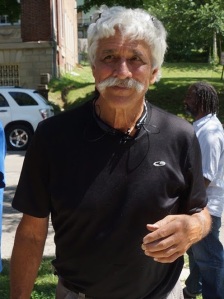
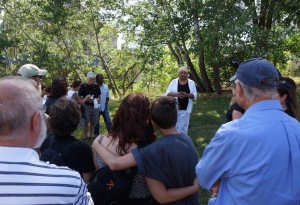
The Adams County Historical Society held its Annual Cemetery Tour last Saturday.  I’ve served as researcher, script writer, tour guide–and ghost–for the Adams County tours for five or six years now.

headstone

Headstone of 19-year-old Lewis Knight, one of six men of Company E, 16th Wisconsin, who died at Shiloh in 1862. Strong's Prairie Cemetery, Adams County.

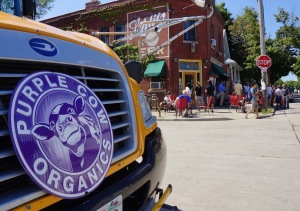
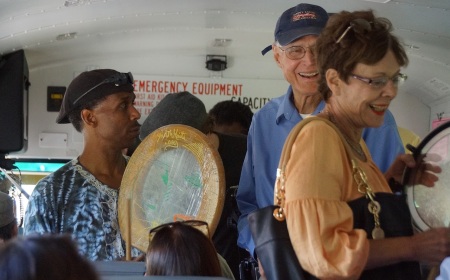
Our county has always had a small population spread over a large area, which means we have several dozen cemeteries located throughout a couple dozen towns.  Our modus operandi, therefore, is to load up a school bus full of ghost hunters, travel to two country cemeteries, meet five or six ghosts in each, then adjourn to a nearby country church whose members feed us a home cooked dinner that is worth the trip all by itself.

At the cemeteries, our tourists find ghosts poised at their graves, in period clothes, waiting to come to life and tell their stories.  Given the right story and the right ghost, they/we are transported to the past. The setting eases the journey. There is something about a graveyard that prompts reflection, opens us to past lives, our own and others.

Selecting ghostly storytellers can be a challenge.  As it is among the living, the population of our county among the dead is rather small.  Records are often absent. Memoirs few, and the editors of our weeklies did not pen lavish obituaries on everyone who passed, even in the era when such obits were standard newspaper fare.

So the first rule of selecting ghosts is that we actually have to know enough about a person to tell their story. No fiction, at least not deliberately, although this writer is sorely tempted not to let the facts impede the telling of a good story.

In part because records are available, but also because the sacrifice was so great, we visit with the ghost of one Civil War veteran each year.  In proportion to its population Wisconsin suffered more casualties in the Civil War than just about any other northern state. Evidence of that sacrifice is found in our cemeteries.

Of course, we visit the graves of the conventionally significant–the “firsters” who founded the towns, left their names on the map, acquired a measure of wealth, fame or infamy.

We also try to find the ghosts of  ordinary folks, or at least those generally perceived as ordinary, even though we know every grave in every cemetery marks a life unique unto itself.

So we find the 19th century farm “wife” remembered as the mother of six, eight, a dozen children, who invariably lost one or more in infancy. The tiny stones of the babies flank  her marker like children gathered round to hear her tell a pretty story–as perhaps she once did in life.

We also look for the long-lived. On our last tour, we visited the ghost of a woman born in 1899 who died in 2001. She, and we, were able to reflect on change over three centuries.

headstone2

Headstone of Alson Kent at the foot of the only oak tree in Strong's Prairie Cemetery.

Occasionally we have a touchy moment, when the descendant of a ghost appears and wants to be sure we have grandma’s or grandpa’s story straight. We do, usually.

We can’t talk about ghosts without mentioning at least one sort-of eerie experience. In 2008 we told the story of Alson Kent, a seventeen year old boy who died in a logging accident. A huge oak tree he was felling snapped unexpectedly, kicked back off the stump, and crushed the youngster before he could escape.  Coincidentally or not, Kent is buried at the foot of the only large oak in the Strong’s Prairie Cemetery. It matches the newspaper description of the tree that killed him.

See you on the next tour.

–Michael Goc


The producers……

October 28, 2009

“If I’m supporting them, maybe they can support themselves,” exclaims Jacqui and she isn’t talking about teenagers.  She’s talking about her sheep.  Jacqui runs Dumgoyne Farm, named after a hill near her childhood home in Scotland.  She is one of thousands of small agriculture and art producers, the folks behind the colorful stalls at outdoor markets, displays in intriguing little shops and web sites chocked with visually delicious offerings.

Dumgoyne Farm features specialty fibers from “a menagerie”, including a herd of about 60 sheep.  I don’t want to forget the llamas.  (And I’ve learned that llamas have fiber, not wool.)

dum-herd

"The flock's in the forest," says Jacqui.

Jacqui’s comment about the sheep supporting themselves comes from the fact that many of her wards are rescue animals.  She gave them a home so now their wool can help pay their room and board.  And it does.

Small producers of agricultural and related products are important economically, and their numbers seem to be on the rise.   In Lafayette County, near where I live, 40% of the labor force is self-employed.  That‘s a lot.  Half of those workers are farmers.  And consumers of all stripes seem to be seeking better knowledge of where their stuff comes from which bodes well for the smaller businesspeople.

In this instance, Dumgoyne is an offshoot of a larger agricultural concern and provides additional “value-added” income through the sale of quality fibers.  You can pick-up a ram lamb, too, if you’re in the market.  They feature registered Icelandic sheep and various other breeds comprise the rest of the herd.  The attraction is obvious: Dumgoyne Farm’s fibers are rich and extraordinary.

Products are marketed through Savor Wisconsin (a great, free service to buyer and seller alike), at a wool and fiber expo, through a web page and Dumgoyne especially word-of-mouth.  “Some of the people I sell to have unbelievable skills,” says Jacqui.  “They’re crafty people, if I may.  We know each other, help each other out.”dum-wool1

Among other reasons, it is obvious agriculture is a means to an end in this case.  Caring for rescue animals is an important part of Dumgoyne Farm because it is an element of the belief system of the farmer:  Jacqui loves being with and having animals.  The last time I called Dumgoyne Gus the macaw was doing some serious decibels in the background and other birds were making a chorus of it.  The dogs watch over the sheep and occasionally warm the couch if needed.  Small animals, large animals, birds and bunnies – all have a place there.

dum-llama

Khazimir wonders who's reading this

The sheep support more than themselves.dum-wool2

Farming of any kind is hard work, especially in winter and if the operation involves animals.  “Sheep can get stuck in the snow”, says Jacqui, so she uses the pasture nearest the house.  Hard, prolonged winters create havoc with watering and feeding and stress animals and people alike.  Trucks, skid steers, tractors and almost anything with a motor will give you problems.  It isn’t an easy occupation and it carries a lot of risks and less control sometimes than one would hope for.

That being said, spring, summer and fall can be pretty nice.                      dum-wool3

If there’s a common thread to what makes many of the farmers I know tick, it seems to be lifestyle and independence.  A lot of these folks would farm regardless of the type of operation – they like being outside, they’re the decision-maker and they could be content in differing types of farming.

dum-mask

A woolen mask and hands. Happy Halloween!

Some like to market their goods directly – meet the customer and share the story.  Others are less gregarious.  Some are truly committed to a rural lifestyle and others to producing the healthiest consumables they can.  Some are the latest of many generations in the same business.

I’m going to make an effort to talk to more producers over the next month or so – maybe blog a bit more about what I learn.  Their perspective is a part of the connection that may have been be a bit lost over the last few decades.  But it is starting to be found again through the success of Buy Local movements and the efforts of caring consumers who demand to know where their goods come from and that those who produce them get a fair shake.  That’s a partnership we all can bank on.

Rick Rolfsmeyer, Wisconsin Rural Partners

Hollandale, WI (Pop. 283)


It’s all part of our history

October 21, 2009

I read today that the average fuel efficiency of U.S. cars has improved by three miles since the Model T Ford. In other words, according to the study by the University of Michigan Transportation Research Institute, in the last 101 years, American cars are only getting an average of three more miles to the gallon.

In the same publication, I also read that the Court of Appeals for the Ninth Circuit restored protections of more than 40 million acres of public land. This overturned what the last President did to make what the preceding President had done valid once again.

I think we can learn a lot from history. I gather American car manufacturers have had other things on their minds and American Presidents don’t share a consistent vision for public lands.

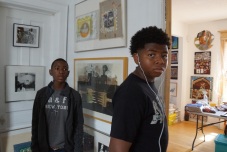
Actors Patrick and Samuel Porter in "Camp We-Kan-Tak-It" at the Boerner Botanical Garderns. Photo by Debbie Kmetz.

Actors Patrick and Samuel Porter in "Camp We-Kan-Tak-It" at the Boerner Botanical Garderns. Photo by Debbie Kmetz.

One historical and notably American act I’ve always thought seemed sensible is the Civilian Conservation Corps. After a performance by the Milwaukee Public Theatre called “Camp We-Kan-Tak-It” about life in a CCC camp I attended last week, the audience was asked “Would this work today?”

Seventy four years ago, the Emergency Conservation Work Act was signed into law by President Roosevelt. The largest peacetime army in history, the Civilian Conservation Corps was mobilized to improve domestic infrastructure.

I’ve romanticized the whole thing, smiling proudly when reading a memorial at a state park commemorating the work of the CCC and lately rooting for our current President’s talk of creating jobs, stimulating the economy, and restoring National Parks with a modern Conservation Corps.

The performance only encouraged my hopefulness. The script and musical lyrics were written by a small team of historians and enthusiasts to convey the concerns of the day, the reasons men had for enlisting, and what life was like living in the camps. I learned that the men made $30 a week for 40 hours of work, but kept only $5. The rest was sent home to their families. There were also classes offered at night, such as a journalism class that produced a camp newspaper.

“The Humdinger,” a resource guide produced by Voices Theater and the Milwaukee Public Theatre to resemble a CCC camp paper, explains: “From 1933 to 1942, the CCC gave jobs to three million unemployed young men, brought relief to their families, and helped conserve America’s natural resources.”

The rates of unemployment in Wisconsin cities have pretty much doubled in the past 12 months. Milwaukee’s stats have risen from 5.5% to over 10%. This is nothing close to the national average during the Depression, which soared as high as 75%. Thank goodness! But why wait until we’re in utter crisis to take a lesson from history?

Clearly, there is much of American history to be proud of. I say use the wisdom of experience to shape a positive future.  As for auto engineering, I hope there are many good ideas yet to be had.

by Jessica Becker, Director of Public Programs at the Wisconsin Humanities Council.